
Author

Mark Bedard
CEO and Founder
Are you paying too much for your sales stack?
Most revenue leaders know the feeling: budgets tighten, quotas rise, and suddenly every software license in your stack comes under the microscope.
And here’s the kicker—according to a 2025 report cited by TechRadar, organizations are spending between $9,000 and $17,000 per employee annually on SaaS — yet a staggering 30% to 50% of that budget is wasted on unused licenses and auto-renewals. That’s money sinking into tools that slow down workflows instead of streamlining them. Given that efficiency is currency in modern sales, the inefficiencies buried in SaaS sprawl become a silent tax on your growth.
The real question is: Are your tools making your reps faster and more effective—or are they quietly draining your budget and slowing teams down?
In this article, we will help you rethink your stack, cut the bloat, and unlock new levels of sales efficiency without sacrificing results.
The quiet tax of bloated sales stacks
Too often, companies believe adding more tools equals more productivity. But every new platform adds hidden costs:
License bloat: Paying for seats that go unused or features no one touches.
Integration overhead: Complex syncs between tools drain RevOps time and create brittle workflows.
Data chaos: Each tool applies its own logic, which clogs the CRM with duplicates and inconsistencies.
Training tax: Every additional platform requires onboarding, ramp time, and support.
The result? More tools usually mean less sales efficiency. Research from Productiv’s 2024 SaaS Management Benchmarks found that more than half of SaaS licenses go unused in a typical month. Every unused seat is wasted budget — and when the stack is fragmented across too many sales tools, that waste multiplies into inefficiency and lost productivity.
And the impact isn’t just felt by sales reps. RevOps is left holding the bag: managing brittle integrations, reconciling conflicting datasets, and cleaning reports that never quite line up.
Questions to ask about every tool in your stack
A lean stack starts with asking better questions. Here are the five that matter most:
Is this tool actively used?
Be honest. If fewer than 60% of licensed reps log in weekly, the ROI isn’t there.Does it integrate cleanly into workflows?
If it forces extra steps or creates “shadow work” outside the CRM, it’s lowering sales efficiency.Are features overlapping with another tool?
Dialers inside CRMs. Sequencing tools inside data platforms. Redundant enrichment contracts. Redundancy is money wasted.Is it scalable to the whole team?
If only a handful of AEs or SDRs can use it because of cost, you’re creating workflow inequality.If we cut it tomorrow, what happens?
If the answer is “not much,” you’ve got shelfware.
This isn’t just theory. Forrester found that 53% of B2B companies admit to paying for tools that overlap in functionality. Imagine the sales efficiency gains if you trimmed even 20% of that waste.
The hidden costs of tool sprawl on sales efficiency
At first, stacking more tools feels like progress. Each promises a new feature or automation that fills a gap. But when you zoom out, what you really get is overlap, wasted spend, and systems that don’t talk to each other.
Instead of empowering sales reps, a bloated stack often slows them down. They jump between logins, copy-paste across platforms, and spend more time managing tools than engaging buyers. And when data doesn’t flow cleanly between systems, RevOps is left patching holes instead of driving strategy.
It’s also incredibly expensive. A recent study by Allego found that companies wasted an average of $313,000 on sales tools that weren’t fully adopted by reps over just the past two years. Even more telling, 76% of companies admitted that poor adoption of sales tools is one of the top reasons their teams miss quota.
Did you know?
Companies report wasting an average of $313,000 on sales tools that reps never fully adopt.
This isn’t just about licenses. It’s about lost time, inconsistent reporting, and a CRM that’s more chaos than clarity. Those hidden costs stack up fast—and they’re often invisible until you step back and audit the workflow.
Why fewer tools drive higher sales efficiency
Cutting tools might sound risky—like you’re giving up capabilities. In reality, fewer tools often drive better sales efficiency because every rep works from the same playbook.
With a leaner stack, training is easier, adoption skyrockets, and RevOps doesn’t waste cycles untangling mismatched processes. Reps can spend their energy on calls, not figuring out which platform holds the right data. And leadership finally gets cleaner, more reliable reporting because data isn’t scattered across half a dozen systems.
This is where the upcell model comes in. Instead of juggling multiple platforms, reps start with one affordable Chrome extension, standardized across the sales floor. Every prospected contact follows the same process: ownership, tags, and context are applied in a single click, and the record flows directly into your CRM and engagement tool.
Because the model is affordable, companies can equip every rep — not just a handful of top performers. And because it’s flexible, RevOps can layer in additional data providers where coverage is needed without locking the team into an expensive, all-in-one platform.
CSO Insights found that sales teams with simplified stacks saw 19% higher quota attainment than those managing bloated tech. Fewer tools don’t just save money — they directly improve sales efficiency and performance.
Less complexity. More coverage. A cleaner CRM. That’s what sales efficiency actually looks like.
Unifying the stack without replacing what works
Here’s a scenario that plays out in countless sales orgs. Leadership buys licenses for Cognism, ZoomInfo, and Seamless.AI — not because it’s efficient, but because reps like bits and pieces of each platform and aren’t willing to give up the data they can get from them.
The problem? That approach costs a fortune. And because budgets only stretch so far, not every rep gets full access. Some lose out on certain platforms entirely, which fragments workflows and leaves the CRM full of gaps.
With upcell, you don’t have to make those trade-offs. Equip every rep with the Chrome extension — something you can actually afford to do — and then plug in API keys from ZoomInfo, Cognism, Seamless.AI, or any other provider you choose. Suddenly, every rep uses the same point of entry to capture leads, and you can enrich records with exactly the fields you want from whichever data sources make the most sense.
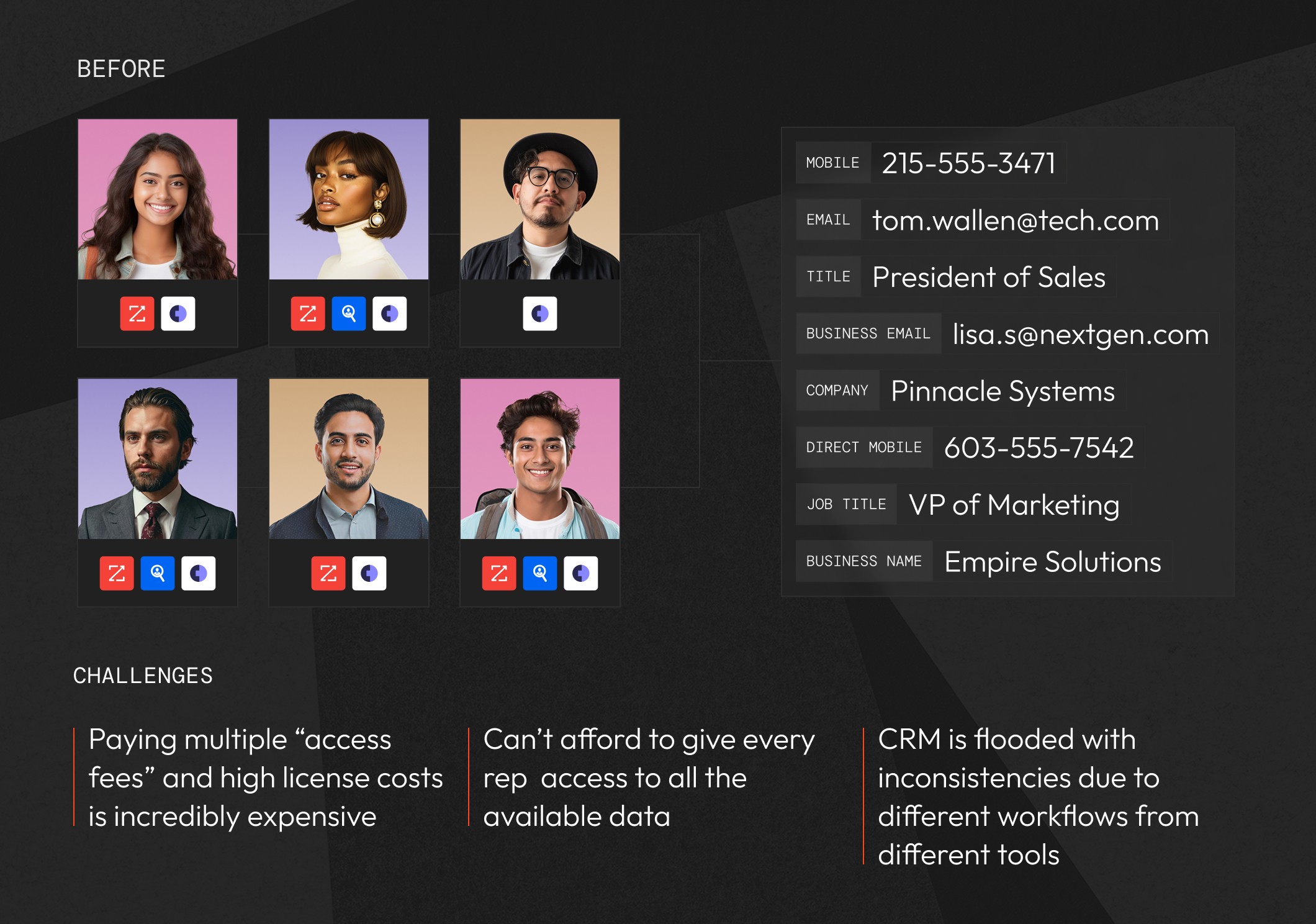
Before: Fragmented stacks = high costs, limited access, and messy CRM data.

After: Unified workflows = every rep equipped, every record enriched, lower spend.
That’s how you cut costs, unify your motion, and finally achieve sales efficiency without compromise.
How to run your own stack audit
Ready to take action? Here’s a simple framework to run a sales efficiency audit on your stack:
Inventory tools: List every tool, its cost, and who actually uses it.
Usage review: Pull usage reports. If adoption is under 60%, flag it.
Feature overlap: Map functionality. Highlight redundancies.
Impact analysis: Ask what breaks if you cut it. If the answer is “not much,” it’s expendable.
Consolidation opportunities: Explore where one streamlined workflow could replace two or three platforms.
The goal isn’t just to save money. It’s to create a stack that enhances sales efficiency by reducing friction, boosting adoption, and giving RevOps cleaner control.
Final thought: stop paying for shelfware
The sales tech landscape has exploded, and while innovation has its benefits, too many teams are stuck paying for bloated stacks they barely use. The answer isn’t to rip and replace everything — it’s to unify the tools that already work, simplify the motion, and give every rep the same efficient workflow.
Sales efficiency isn’t about adding more. It’s about cutting what doesn’t work. The question is: how much are you overpaying for sales tools right now?