
Author

Justin Sweeney
CTO and Founder
The AI-Ready Data Mesh: Why RevOps Needs Multi-Vendor Enrichment.
Every sales platform is talking about AI. Predictive routing, generative outreach, autonomous SDRs—the promise is endless. But behind the flash, most GTM teams are realizing something uncomfortable: AI is only as smart as the data it's fed.
If your CRM is cluttered with duplicates, outdated contacts, or missing firmographics, even the most advanced AI turns into a glorified automation engine. It’ll send perfect emails—to the wrong people. It’ll prioritize accounts that went cold months ago. It’ll recommend “next best actions” based on broken signals.
The truth? AI doesn’t know where the right data belongs. That’s RevOps’ job.
And as we move into 2026, forward-thinking GTM teams are adopting a new operational model—one that gives RevOps full control over how data flows into the stack, not just which vendor provides it.
That model is called the multi-vendor enrichment model, and upcell is building the architecture that makes it possible.
What “AI-ready” really means for GTM
“AI-ready” doesn’t mean you bought an AI assistant. It means your data infrastructure is clean, connected, and flexible enough to feed any AI you adopt next year—or five years from now.
An AI-ready GTM stack has four key traits:
Clean: every CRM record is enriched, verified, and compliant.
Complete: every account has mobile, email, and firmographic context.
Connected: enrichment flows seamlessly into your CRM and engagement tools.
Controlled: RevOps decides how and where data is applied—across every vendor.
That last point is where most teams fall short. Traditional sales data platforms try to own enrichment end-to-end, forcing you to live inside their dataset. The result? Blind spots, overlapping feeds, and a loss of control.
The multi-vendor enrichment model flips that dynamic. Instead of depending on one dataset, RevOps orchestrates many—with upcell as the lightweight layer that keeps it all synchronized and compliant.
How the multi-vendor enrichment model works
Think of your GTM stack like a data mesh: multiple sources feeding a single, governed system.
With upcell, that mesh becomes operational. RevOps plugs in multiple data providers through simple API connections—and orchestrates them through one unified extension.
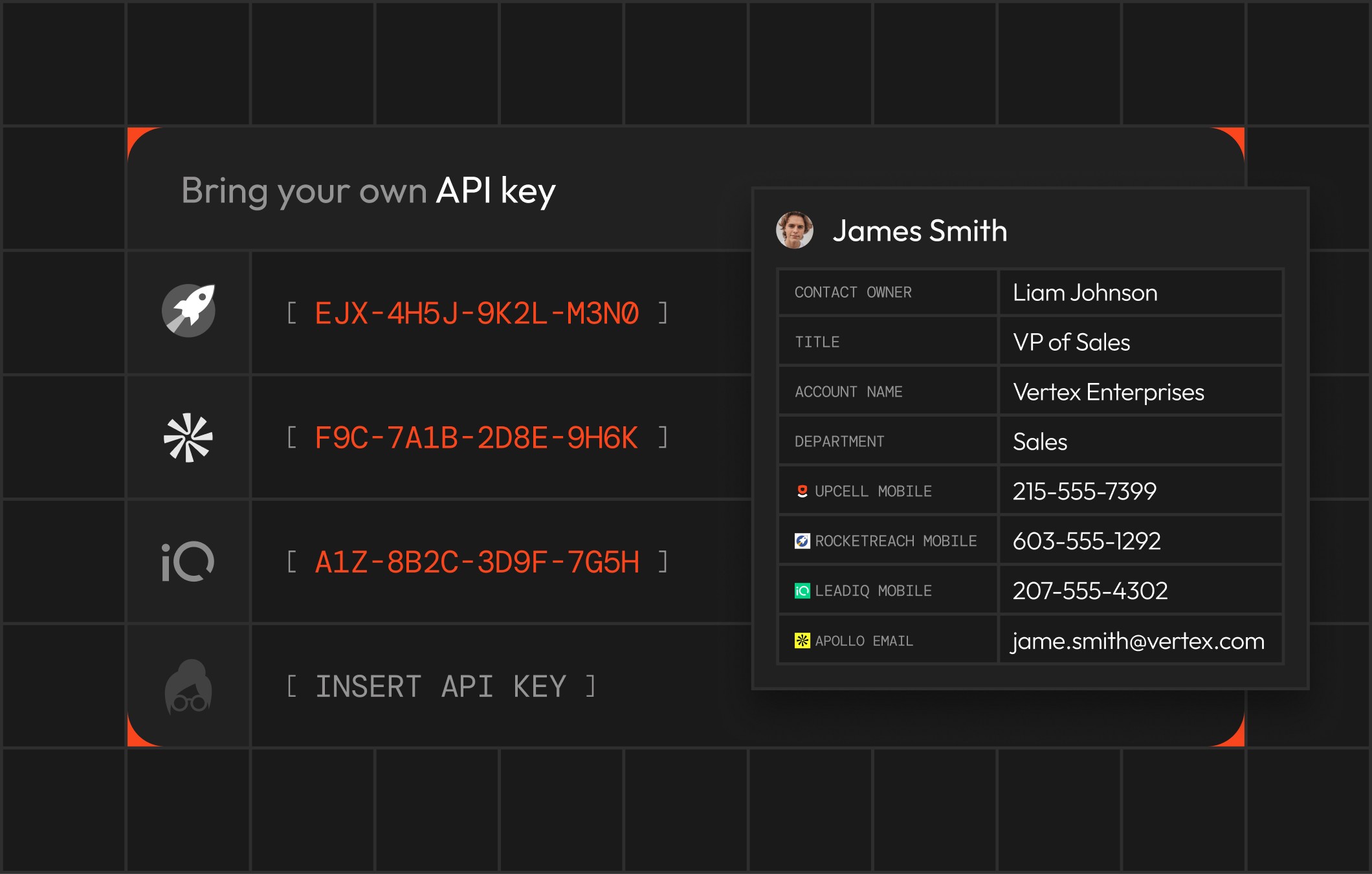
That’s the multi-vendor enrichment model in action:
One workflow for reps. They don't have to switch between multiple tabs, only focusing on prospecting while enrichment happens behind the scenes.
Multiple data sources. RevOps combines the best provider for each field and region, without forcing reps to toggle or copy-paste.
Centralized control. Governance rules determine which source populates each field, eliminating duplicates and inconsistencies.
Automatic enrichment. Every CRM record stays clean, compliant, and ready for AI-driven workflows.
The result? A cleaner CRM, faster adoption, and AI models that finally have the complete context they need to perform.
Why AI can’t replace data orchestration
AI has become shockingly capable—but it still doesn’t understand context. It can’t determine which mobile number is most recent, which email domain belongs to the right subsidiary, or which signal actually indicates purchase intent.
Left alone, AI automates chaos.
That’s why orchestration matters. upcell sits between data and automation—ensuring AI always pulls from the right source, at the right time, for the right contact.
When RevOps governs enrichment at the source level, AI copilots suddenly become useful instead of noisy.
Automated outreach tools stop sequencing dead inboxes.
Predictive scoring models stop overvaluing junk leads.
Coaching insights become accurate because ownership, region, and activity fields are complete.
AI can automate motion. But only RevOps can guarantee order.
Why platforms overpromise (and underdeliver)
The big all-in-one vendors love to sell “AI that just works.” But under the hood, they’re limited by their single-vendor architecture:
Coverage gaps. No provider is best-in-class across every region, vertical, and data type.
Rigid pipelines. You can’t change how or when enrichment happens.
License bloat. You pay for bundled AI features and unused seats.
Data chaos. Multiple overlapping feeds create duplicates and compliance risk.
That’s why enterprises waste an average of $17M annually on unused SaaS licenses.
upcell takes the opposite approach. Instead of locking you into one dataset, it unlocks all of them—through a controlled, RevOps-led model that delivers cleaner data at 30–70% lower cost.
Blueprint: Building your AI-ready data mesh
Building an AI-ready GTM architecture doesn’t mean a complete rebuild. It means adopting modular principles and layering control where it matters most.
Here’s what that looks like in practice:
Unify the workflow. Standardize prospecting and enrichment inside the upcell Chrome extension so every rep works from the same interface.
Activate multiple providers. Connect your chosen vendors through API.
Define governance rules. Decide which source powers which fields, and in what order. RevOps sets the hierarchy, not the vendor.
Automate enrichment to CRM. Every contact and account is updated automatically—no spreadsheets, no manual uploads.
Layer AI responsibly. Once the data is consistent, AI tools like forecasting, coaching, and sequencing finally perform as intended.
Each step compounds value: higher data trust, lower waste, faster adoption, and AI that works off truth—not noise.
2026 and beyond: future-proofing GTM
By 2026, AI won’t just assist—it will act. Autonomous GTM agents could be handling prospecting, lead routing, and outreach sequencing. But if those agents are running on bad data, your brand reputation and revenue are at risk.
The winners of the next sales era will be the teams that treat data orchestration as a strategic function—not an afterthought.
That’s what the multi-vendor enrichment model is really about:
Giving RevOps the architecture to control how data moves through the stack.
Giving Sales leaders confidence that their teams (and AI copilots) always work from accurate, current records.
Giving the business measurable ROI—lower spend, higher connect rates, cleaner CRM data.
AI is evolving fast. But flexibility will outlast every wave of hype. And flexibility starts with multi-vendor control.
Conclusion: modular beats monolithic
AI isn’t the future of sales—it’s the layer that depends on it. Without a solid foundation, every “AI-powered” promise collapses under its own data debt.
The multi-vendor enrichment model, powered by upcell, is how RevOps and Sales leaders stay ahead:
Modular, not monolithic. Build your stack like Lego, not like a black box.
Flexible, not fixed. Add or swap data providers as the market evolves.
Governed, not chaotic. Keep data compliant, connected, and under your control.
The result is an AI-ready GTM stack that doesn’t just keep up—it leads.